











John Wilmot, 2nd Earl of Rochester (April 1, 1647–July 26, 1680) was
a friend of King Charles II, and the writer of much satirical and bawdy
poetry. He was the toast of the Restoration court and a patron of the
arts who famously drank and debauched his way to an early grave, only
to earn posthumous critical acclaim for his life's work.
In the film, The Libertine, which was released in Australia this
week, the Earl of Rochester is played by Johnny Depp. It also stars
John Malkovich and Samantha Morton. Directed by Laurence Dunmore,
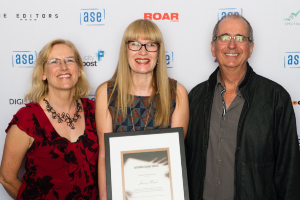
produced by Malkovich, the film was edited by Jill Bilcock ASE. I met
with Jill in Melbourne just after she had finished cutting, I was lucky
to get a sneaky peak of Johnny Depp's opening monologue before we
started chatting about the film.
----------------------------------------
Tell me about working on The Libertine...
Working on The Libertine was fantastic.
It was with a first time film director who had just met John Malkovich
when he did a TV commercial for him. He was a commercial director named
Laurence Dunmore and Laurence had decide that he wanted me to edit, so
he tracked me down (I don't have an agent) and we started talking. Its
a fairly low budget movie, he asked me if I wanted to do it, I read the
script and the script was fantastic. The screenplay is by Stephen
Jeffreys who also did the play. The Libertine is his first screenplay.
There were a lot of really nice people on the project, Johnny Depp was
a big drawcard of course, as well as John Malkovich and Samantha
Morton. The design team were the Dutch group that did Girl with the Pearl Earring. So it was good.
Before I went over to England, where they were shooting I said
that I would like to have some of the editing done in Australia. They
said that if I did the film, they could accommodate that. And they did.
We spent the shoot over there and I did the Directors Cut, which was
ten weeks. It was actually very straightforward and Laurence was very
helpful with selection of takes during the shoot. I was in London and
they were away on the Isle of Man. So, we talked every day. We then
showed it in England and everybody liked it.
I then brought it back to Australia - Laurence didn't come over. To
start we did a rough mix before it went to the Toronto International
Film Festival as a Work In Progress. It was quite long then, with
many more scenes in it, there were some fabulous other scenes - quite
outrageous. We had much more of a decadent feel to it, than it
has turned out to have. Then at Toronto - Harvey Weinstein bought it -
which is when notes started coming - they wanted massive changes and
they wanted to change the style of the movie - it became an ongoing
battle. Before that, the film had a bit more humour and a lot more fun
in it. It was definitely a bit too long, but that normally solves
itself as you do the finecut.
There is a device used at the beginning and at the end of the film,
which is Johnny Depp talking to camera. They wanted that to happen all
the way through, and we didn't so... after a lot of deliberation we all
came to an agreement of more or less, what could come out and what
should stay. It is very interesting to see both versions. There is
another character in the movie originally - in the Toronto version -
that isn't there anymore.
When the film screened in Toronto as a Work In Progress - did you find that exposing?
I love it. Its the only way to find out whether a movie is working.
Unfortunately, I wasn't there and on this film it actually took a
little longer to get to the final result as I wasn't at the test
screenings - you can usually tell by the feel of the audience straight
away - if the film is too long or things you thought were funny,
aren't. Its good to be exposed. I don't like the studio system very
much. You can generally tell if a film is working and what type of
audience the film will eventually reach by having screenings.
After Harvey came in, we did all get beaten down a bit, but I think
Laurence did win major points with Harvey because Harvey really wanted
to sanitise it and make it so boring that we just couldn't let it
happen. He wanted to make it more accessible, but this was always going
to be a movie that not everyone wants to see. The Earl's poetry is so
explicit, there's nothing in the film that is disgusting or sexually
explicit, it is tonally quite down.
Was it difficult to bring the film back to Australia?
It was contracted. For me, it helps to get home. Nine to twelve months
is too long to be away and it also helps to have other Australians
working with you, people that you know and use the same kind of backup
that I'm used to.
What was John Malkovich like as a producer?
He was good. It was very hard for John - he actually played the Earl of
Rochester on the stage, so Johnny Depp was playing "his role" and I
think that made it quite hard for him to be objective. He kept pretty
well out of it and let Laurence do what he wanted to do and let Johnny
play the part the way he wanted to play it. At times I feel Laurence
would have wanted more help from John, but he thought he was doing the
right thing in stepping back. Also, as John has directed films himself
- I think he knew just how hard it can be, so he showed Laurence
respect.
The film is a period piece and starts with titles explaining the setting - how important is exposition like that in these films?
You needed to set the period with that extra information at the
beginning. The film itself expresses the period well. Its very dark,
its very muddy, its very seamy and depicts the era extremely well. The
era was also quite sexually liberated at that time, language was foul
and that’s why it got more than an R rating in America to start with -
we needed to take some material out to get the R. The times were pretty
wild.
What was it like working with first time film director Laurence Dunmore?
Most of the Directors I've worked with haven't made a lot of movies. I
prefer it that way because they're still terribly excited about what
they are doing. And, not open to pleasing anybody else. It makes the
fight a little tougher, especially when working with someone like
Harvey Weinstein. Because they are passionate and believe in what
they want to do - they haven't been worn down by studio experience yet
so creatively they tend to step into areas that are much more
interesting as opposed to some people who have been making films for
the last thirty years.
Did you find you had to nurture Laurence at all?
I taught him my system - which was a bit rigid. Poor Laurence. Every
night he would go home and with his sheets of every slate, he would
fill out a comment. If he didn't like it he wouldn't write anything,
but he would have to give me feedback on a day's rushes so that at
least I knew what performances he liked and what it was in the material
he liked. Also, he wasn't only directing the film, but was
holding the second camera on his shoulder which is the main camera used
for the whole movie. The DP lit it and had first camera - which was
wider and more static - and Laurence did most of the close-ups and
movement. Laurence was extremely passionate, he worked very hard and he
was very good at getting his notes back. Because I wasn't on the set or
on location and didn't know him very well it was very important for me
to get constant feedback, straight away. And we also re-shot two
scenes as we went, due to me saying that I didn't think they worked, he
then scheduled it in and re-shot it and he came in half a day under on
his shooting time.
Tell me about establishing trust with your director?
He gave me a lot of time - he always listened to advice. I told
him to do what he needed to do and that if I thought something wasn't
working emotionally - I would let him know. He responded very well to
that, and the trust was there, I think, from day one.
Did you find there was a difference between working with Laurence and
other directors because he had such a strong background directing TVCs?
I come from the same background - an Art background and I've done heaps
of commercials too and that helped me understand his impatience and
speed. What it did give him was the asset of being extremely well
prepared. He had done lots of research, he'd done lots of drawing of
how he saw it and then of course as always happens - changed his mind
as soon as he got out there. He was quite disciplined and extremely
driven.
And finally, what was it like cutting Johnny Depp?
It was wonderful, he was brilliant and as you can see - that opening
prologue which goes for a couple of minutes, he only did four takes of
it and they were word perfect every time. He can do huge stretches of
dialogue and not drop words or forget things. He was also very helpful
to the other actors...
----------------------------------------
The Libertine opened in cinemas nationally on 27th July 2006. It is screening at a cinema near you.
Emma McCleave.
Location: Paddington RSL Club, first floor \"Regency Bar\".
Address: 220-232 Oxford Street, Paddington, NSW.
Date: 28.10.2006
Time: 3pm
Parking is available.
read more...